

In today’s world of endless job applications, it’s not unusual to find highly educated, skilled, and experienced professionals struggling to secure the job they deserve. Many of them hold advanced degrees, possess years of experience, and know their field inside and out, yet they face rejection after rejection.
Why?
Not because they lack ability. Not because they lack knowledge.
But because they fail to express that knowledge confidently and clearly during interviews.
The Core Problem: Communication Overlooked
Most applicants spend countless hours perfecting their résumé, tailoring their cover letter, and studying how Applicant Tracking Systems (ATS) work. They learn how to get shortlisted. But very few prepare for what truly matters next — the interview conversation itself.
They know what to say, but not how to say it.
They know their skills, but can’t communicate their story.
This communication gap turns otherwise strong candidates into average performers in the eyes of employers.`
My Field Research: What 70 Jobseekers Revealed
Over the past year, I conducted a field research study with more than 70 jobseekers across Canada and the UK.
These individuals represented diverse industries, from business and finance to education, IT, and hospitality. Our discussions took place in person, over phone calls, emails, and through Zoom meetings.
Every single participant had similar experiences:
- They had strong educational backgrounds.
- They had professional experience and even certifications & Licenses.
- Many were shortlisted for interviews at universities, ministries, and top organizations.
Yet, almost all faced multiple rejections.
When I asked deeper questions — “What did you feel during the interview?”, “How did you express your experience?”, “What feedback did you receive?” — a clear pattern emerged.
Most of them realized the issue wasn’t their qualifications or résumé… it was their lack of communication confidence during interviews.
They spoke too quickly, failed to structure their answers, and struggled to connect naturally with interviewers. Some even admitted they were “overly nervous” or “too formal.”
The result?
Even with exceptional backgrounds, they were outperformed by candidates who simply spoke better — not necessarily those who knew more.
A Real Story: The Master’s Graduate Who Couldn’t Break Through
One participant, whom I’ll refer to as Kabir (name changed for privacy), stood out from my research group.
He had completed his Master’s degree in Human Resource Management from a reputed Canadian university. With over five years of experience in administration and payroll, his technical knowledge was outstanding.
He applied for roles in public service, universities, and private firms, and got shortlisted almost every time. But when it came to the interviews, things fell apart.
During the interview, he spoke too fast, avoided eye contact, and delivered long, complex answers. Interviewers described him as “knowledgeable but distant” and “unable to communicate clearly.” After several rejections, Kabir decided to seek feedback. He politely reached out to one of the interviewers from a recent competition, and she kindly agreed to meet him in person for a short coaching session. During their conversation, she appreciated his strong technical background, professional experience, and impressive academic achievements, but also explained why he did not advance in the hiring process.
Her feedback was honest and constructive: his answers, though accurate, lacked clarity and engagement. Kabir appeared nervous, used complicated phrases, and didn’t build enough personal connection with the panel.
In her words, “You clearly know your job, but your communication didn’t allow the panel to feel that confidence.” That conversation became a turning point for him.
Despite his strong résumé, he kept receiving rejection emails.
Meanwhile, other candidates — with modest education but excellent communication — were being hired for those same roles.
It was a harsh realization:
Degrees and skills may open the door, but communication and confidence determine whether you walk through it.
Why Employers Value Communication Above All
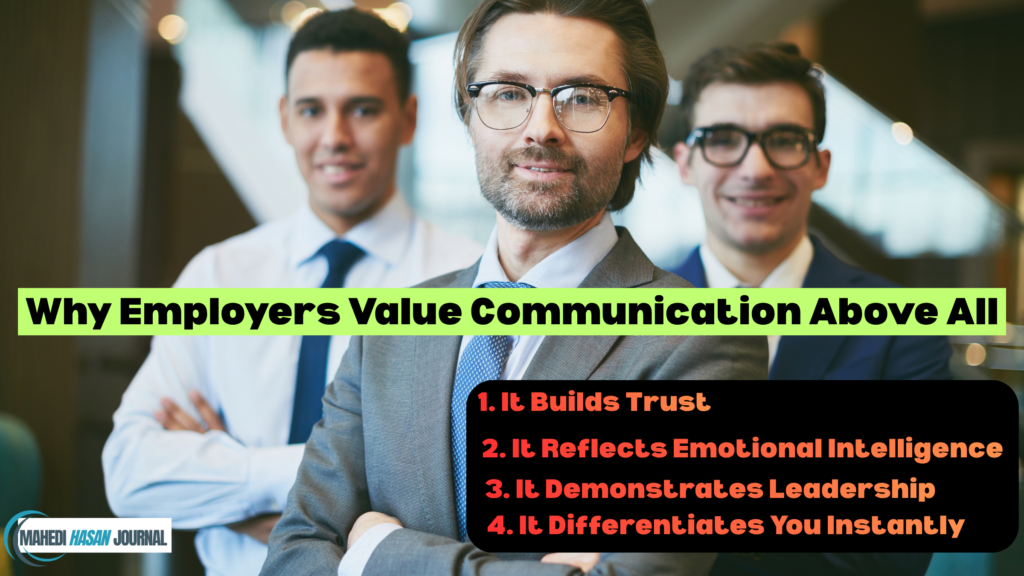
- It Builds Trust
Hiring managers want to know whether you can be relied on — not just for your skills, but for your composure and clarity. When a candidate can explain their thoughts clearly, answer questions calmly, and stay confident under pressure, it creates instant trust.
For example, when an interviewer asks, “Tell me about a challenge you faced,” they’re not only judging the content of your answer but also how you deliver it. A well-structured, steady response signals self-awareness and reliability — key traits in any workplace.
Trust begins the moment you open your mouth, not when they read your résumé.
- It Reflects Emotional Intelligence
Good communication isn’t just about speaking — it’s about understanding. The ability to listen carefully, respond thoughtfully, and adjust your tone shows emotional maturity.
In real interviews, emotionally intelligent candidates are those who don’t rush to answer but take a moment to process the question. They acknowledge the interviewer’s point, maintain polite body language, and demonstrate empathy — whether discussing a past conflict or describing teamwork.
Employers value this because emotionally intelligent communicators strengthen team culture, reduce misunderstandings, and handle difficult conversations with respect. These are qualities that turn good employees into great colleagues.
- It Demonstrates Leadership
Even for entry-level jobs, communication reflects how someone might lead in the future. Leaders are not just decision-makers — they are communicators who inspire trust, clarity, and direction.
In many hiring panels, I’ve seen candidates who weren’t applying for leadership roles but spoke as if they owned their responsibilities. They used confident language like “I coordinated,” “I supported,” or “I ensured the outcome.” Their tone was positive and decisive, not passive.
Such communication demonstrates accountability — a key leadership quality. Employers see these candidates as people who can be trusted with responsibility, projects, and eventually, teams.
- It Differentiates You Instantly
In every competition, dozens of candidates may have similar education, technical skills, or years of experience. But the one who communicates with clarity, confidence, and enthusiasm instantly stands out.
Interviewers often say that within the first few minutes, they can sense who will move forward — not because of qualifications, but because of the energy and engagement the candidate brings to the room.
A strong communicator makes the conversation memorable. They connect their experiences to the organization’s goals, use positive language, and leave the panel thinking, “This person will represent our team well.”
In a world full of skilled professionals, communication is the ultimate differentiator. It’s what turns a résumé into a real human impression.
Transforming Weakness into Strength
The good news is that communication isn’t talent — it’s a skill anyone can learn and improve with the right guidance and consistent practice. Many professionals who once struggled with interviews have transformed their confidence by investing time in structured communication training.
Here’s how you can start improving today:
Practice with Real Questions
Don’t just read interview answers — speak them out loud. Record yourself answering common behavioral questions using the STAR method (Situation, Task, Action, Result).
Then, listen to your tone, pace, and clarity. Are you speaking too fast? Are your answers too long or flat? Self-reviewing is one of the fastest ways to notice and fix weaknesses.
Join a Speaking Club or Workshop
If you truly want to strengthen your communication skills, joining an organization like Toastmasters International is one of the best investments you can make.
Toastmasters has local clubs across Canada, including several active chapters in Regina, such as:
- Plains Toastmasters Club
- Wascana Club Toastmasters
- Wild Oats ClubToastmasters
These clubs provide a safe, encouraging environment to practice speaking, receive feedback, and develop confidence. Members learn how to:
- Speak clearly under pressure
- Handle impromptu questions (just like in interviews)
- Organize thoughts effectively
- Build stage presence and self-assurance
Many successful professionals, managers, and leaders credit Toastmasters for helping them grow into strong communicators.
Explore Local Resources: Regina Public Library
The Regina Public Library also offers online classes on public speaking and communication. These sessions are designed for working professionals, students, and newcomers who want to improve their presentation and interview confidence.
Participants learn practical techniques to:
- Reduce nervousness during interviews or meetings
- Use body language effectively
- Deliver structured, confident messages
- Engage listeners through storytelling
Many professionals in Regina — from business managers to new graduates — have taken these RPL workshops and noticed remarkable improvement in their professional communication.
Simulate Interviews Regularly
Practice mock interviews with a friend, mentor, or career coach. Ask them to observe your confidence, tone, and clarity — not just your answers. Constructive feedback helps you understand how others perceive your communication.
Treat Interviews as Conversations, Not Tests
Remember: interviewers aren’t trying to trap you — they’re trying to get to know you. Speak naturally, show curiosity, and engage in dialogue. Genuine communication leaves a stronger impression than memorized answers.
Show Confidence Through Presence
Confidence isn’t about speaking loudly or perfectly — it’s about staying calm, focused, and authentic. Maintain gentle eye contact, smile often, and take a deep breath before answering. The goal is to connect, not perform.
Improving communication takes time, but every small step counts. Whether through a local club like Toastmasters or a public speaking course at the Regina Public Library, each experience helps you become a stronger, more confident version of yourself — ready to shine in your next interview.
The Turning Point: Kabir’s Comeback
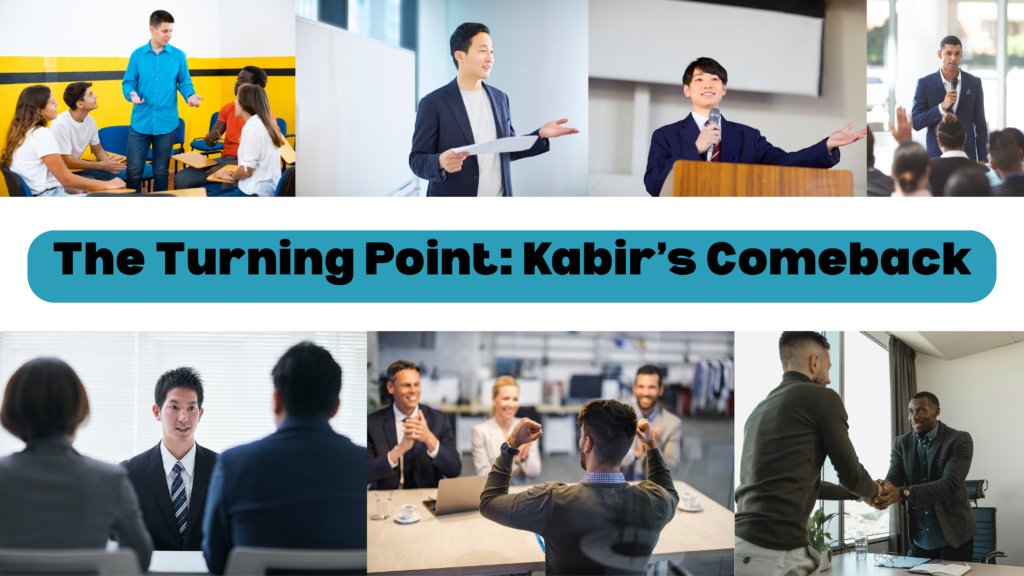
After facing several rejections, Kabir took a step back to reflect on what wasn’t working. He realized that his academic achievements and technical experience were strong — but his communication confidence was holding him back. Instead of feeling defeated, he made a promise to himself: to rebuild his confidence and improve his presentation skills, no matter how long it took.
He began by joining a local public speaking club (Toastmasters), where he practiced speaking in front of others every week. The first few sessions were uncomfortable — his voice shook, his hands trembled, and he often forgot his points halfway through. But the club’s encouraging environment, peer feedback, and structured sessions helped him gradually improve. Over time, he learned to organize his thoughts clearly, manage his tone, and connect naturally with an audience.
To strengthen his career strategy, Kabir also reached out to the Open Door Society in Regina, a well-known organization that supports newcomers and professionals with career development. He was paired with a career counsellor, who guided him through one-on-one coaching sessions. Together, they worked on improving his interview techniques, body language, and professional storytelling. His counsellor helped him understand how to highlight his transferable skills, match his experiences to job descriptions, and approach interviews with authenticity instead of fear.
In addition to the club and counselling, Kabir practiced daily at home. He recorded his answers to common interview questions, replayed them to observe his tone and pacing, and rewrote parts that sounded too formal or robotic. He also joined an online public speaking workshop through the Regina Public Library, which helped him polish his delivery and overcome nervousness in front of groups.
Over the next few months, Kabir became noticeably more confident — not just in speaking, but in the way he carried himself. He learned to smile more, pause before answering, and replace long, complicated explanations with simple, engaging stories from his own career.
Eventually, his hard work paid off. He received another interview invitation — this time for a HR position with the provincial government. But unlike his previous experiences, he walked in calm, focused, and ready. He made eye contact with every panel member, spoke clearly, and conveyed both competence and enthusiasm.
When asked about his challenges and achievements, he shared short, well-structured stories that demonstrated not only his technical knowledge but also his growth as a communicator and leader.
The panel noticed the change immediately. His confidence was steady, his words precise, and his presence professional.
Two weeks later, Kabir received the call:
“Congratulations, we’re pleased to offer you the position.”
Nothing in his résumé had changed — his education, experience, and achievements were the same.
The only thing that changed was his ability to communicate with clarity, confidence, and connection.
His journey proved that success isn’t reserved for the most educated or the most experienced — it’s for those who are willing to learn, practice, and evolve. With persistence, mentorship, and the right support systems, anyone can turn communication from a weakness into their strongest career advantage.
Final Thoughts: Your Knowledge Needs a Voice
Your education, skills, and achievements form the foundation of your career. But it’s your voice, your confidence, and your ability to connect that truly unlock opportunities.
If you’ve been facing repeated rejections despite being qualified, look beyond your résumé — look at your communication. Because success in interviews doesn’t belong to the best résumé — it belongs to the best communicator.
If you’re a professional or recent graduate struggling to succeed in interviews, consider joining Toastmasters or a Regina Public Library communication course. Investing in your voice is investing in your future — because your story, told well, can change everything.